We've adjusted how borrow and supply rates are calculated on Chainflip lending. It's a small change to two numbers that can make a real difference day to day for both lenders and borrowers. Suppliers get a more attractive rate at normal utilisation, and rates should move around a lot less for everyone.
Before getting into the change itself, it helps to know how rates are set. They aren't decided by hand. They come from a curve based on utilisation, which is just how much of a pool's liquidity is currently borrowed. When utilisation is low, there's plenty to lend, so rates are low. As more of the pool gets borrowed, rates climb to bring in more supply and reward the liquidity that's being used.
The curve has an inflection point, a target utilisation level where the slope changes. Below that point rates rise gently. Above it they rise steeply, which pushes back hard against utilisation creeping toward 100%, the level where borrowers can't borrow and lenders can't withdraw. Two numbers set the shape of all this: where the inflection point sits and the rate at that point.
The change
For every asset except BTC, we moved two parameters:
Inflection point: 95% down to 80%
Rate at the inflection point: 4% up to 7%
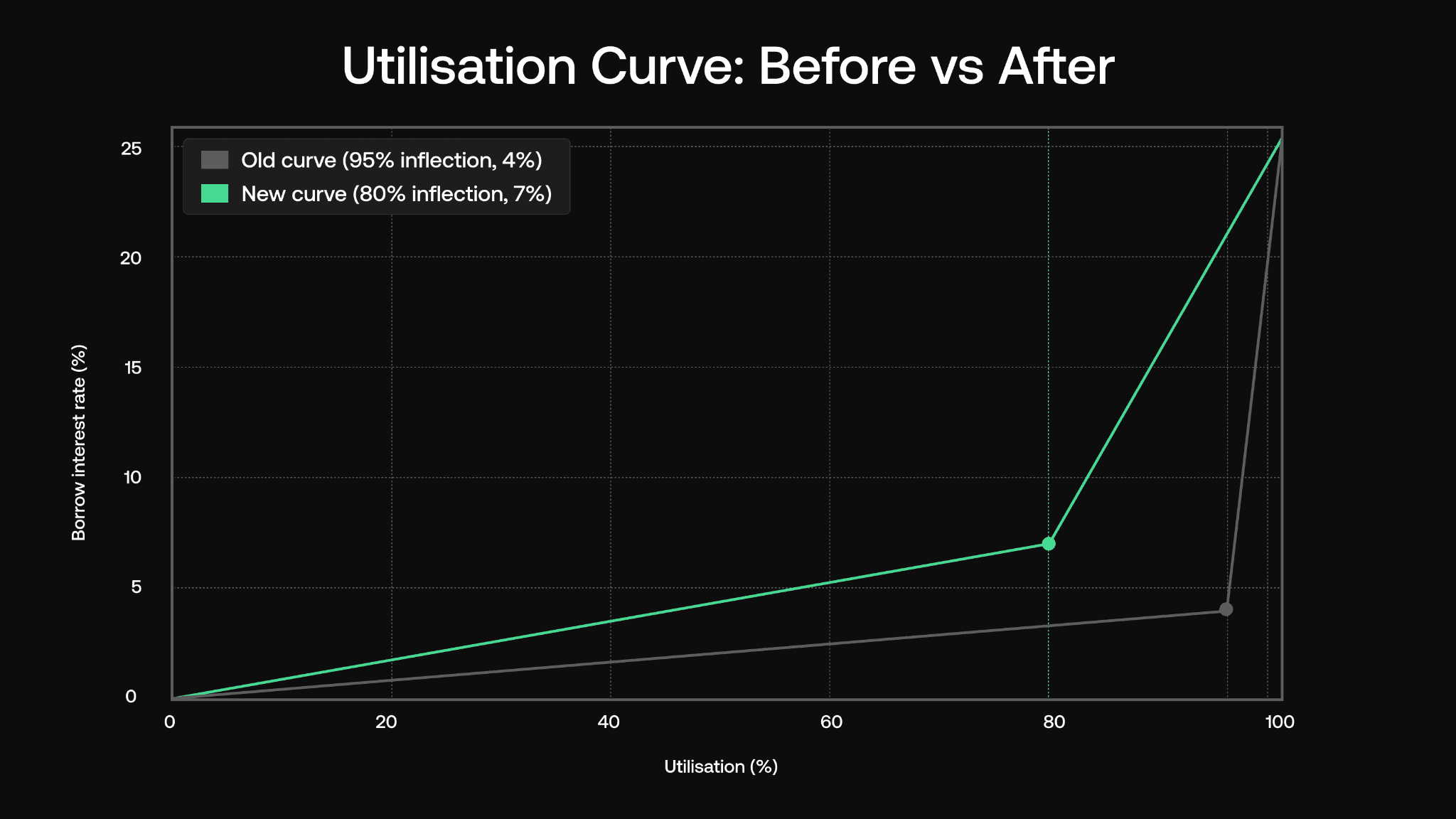
The old curve is in grey, the new one in green. The inflection point moves left and up, and the steep stretch past it gets a lot gentler.
These take effect Thursday, 30 July 12:00 CET, roughly 48 hours from this announcement. Existing positions will be priced against the new curve automatically, so no action is needed from suppliers or borrowers.
The thinking behind it
The inflection point is really our target utilisation, the level we want pools to sit around. At 95% that target was far too high. It left almost no room for anyone to open a meaningful new loan, and it meant the protocol was aiming to run pools with barely any spare liquidity. Dropping the target to 80% gives borrowers space to open real positions and gives lenders confidence they can get their liquidity back out.
There was also the rate itself. At 4% the supply rate at our target utilisation just wasn't attractive. In practice, the only way it became worthwhile for suppliers was when someone pushed utilisation close to 100%, into the steep part of the curve. That isn't sustainable, and it makes for a poor experience: borrowers get locked out and lenders get stuck. Setting the inflection rate of 7% means suppliers get a decent rate at normal utilisation without needing the extremes.
The old shape also made rates jumpy. With the inflection at 95%, the curve was extremely steep across the last 5%, so rates could swing between roughly 4% and 25% on even small transactions. Moving the inflection to 80% widens that upper region and makes the curve about half as steep above the inflection point, which means steadier, more predictable rates for suppliers and borrowers alike. At today's liquidity levels some movement is unavoidable, but this takes a lot of it out.
One more thing changed since these numbers were first set. Back then borrowing didn't come with the incentives it has now. With Lending 2.0, borrowers earn a boosted APY, so borrowing is more appealing on its own. That makes a higher rate at the inflection point well justified and better balanced across both sides of the market.
Why BTC is left out
BTC keeps its existing custom curve (inflection point at 50%) and isn't touched by any of this. It has a special role in the protocol because of boost, and its curve was already tuned around that. Applying the same generic parameters to BTC would ignore that context, so it stays on its own configuration. If BTC's curve needs attention later, we'll handle it as its own decision rather than lumping it in with everything else.
Resources
Swap - Start swapping native assets
Lending - Borrow against native Bitcoin
Blog - Product updates and announcements
Chainflip Scan - Track swaps and network activity
Website - Explore Chainflip
Earn with Chainflip:
Boost - Earn fees by providing single-sided liquidity with no IL risk
Stablecoin Strategies - Deposit stablecoins and earn optimized yields
Provide Liquidity - Supply assets to Chainflip's liquidity pools
Stake FLIP - Delegate FLIP and earn staking rewards
Find us:
FAQ
How does this affect my supply APY?
At normal utilisation levels (around the new 80% target), supply APY sits closer to 7% rather than 4%. You should also see less volatility in your rate, because the curve above the inflection point is around half as steep as before.
Does the new curve apply to my existing loan?
Yes. The new curve applies to all loans going forward. Borrow rates adjust dynamically based on the pool's current utilisation, so any existing position is now priced against the new curve.
Why 80% and 7%?
80% gives borrowers room to open real positions without instantly pushing the pool into extreme utilisation, and it gives lenders confidence they can get their liquidity out. 7% delivers a meaningful supply APY at that target level, so suppliers do not need utilisation to spike near 100% to get paid. The higher rate is also better balanced against Lending 2.0's borrow-side incentives, which pay borrowers a boosted APY on their collateral.
What happens if utilisation hits 100%?
At 100% utilisation, the pool is fully lent out. Borrowers cannot open new loans and suppliers cannot withdraw until someone repays or new supply comes in. The steep rate zone above the inflection point exists specifically to make this hard to reach: rates rise fast enough to attract new supply and discourage further borrowing before utilisation can get there.
Will BTC's curve be adjusted later?
BTC's curve is already tuned around its role in Chainflip Boost, with the inflection point at 50%. Applying the same generic parameters to BTC would ignore that context, so it stays on its own configuration. If BTC's curve needs attention in the future, it will be handled as a separate decision rather than folded into a blanket change.