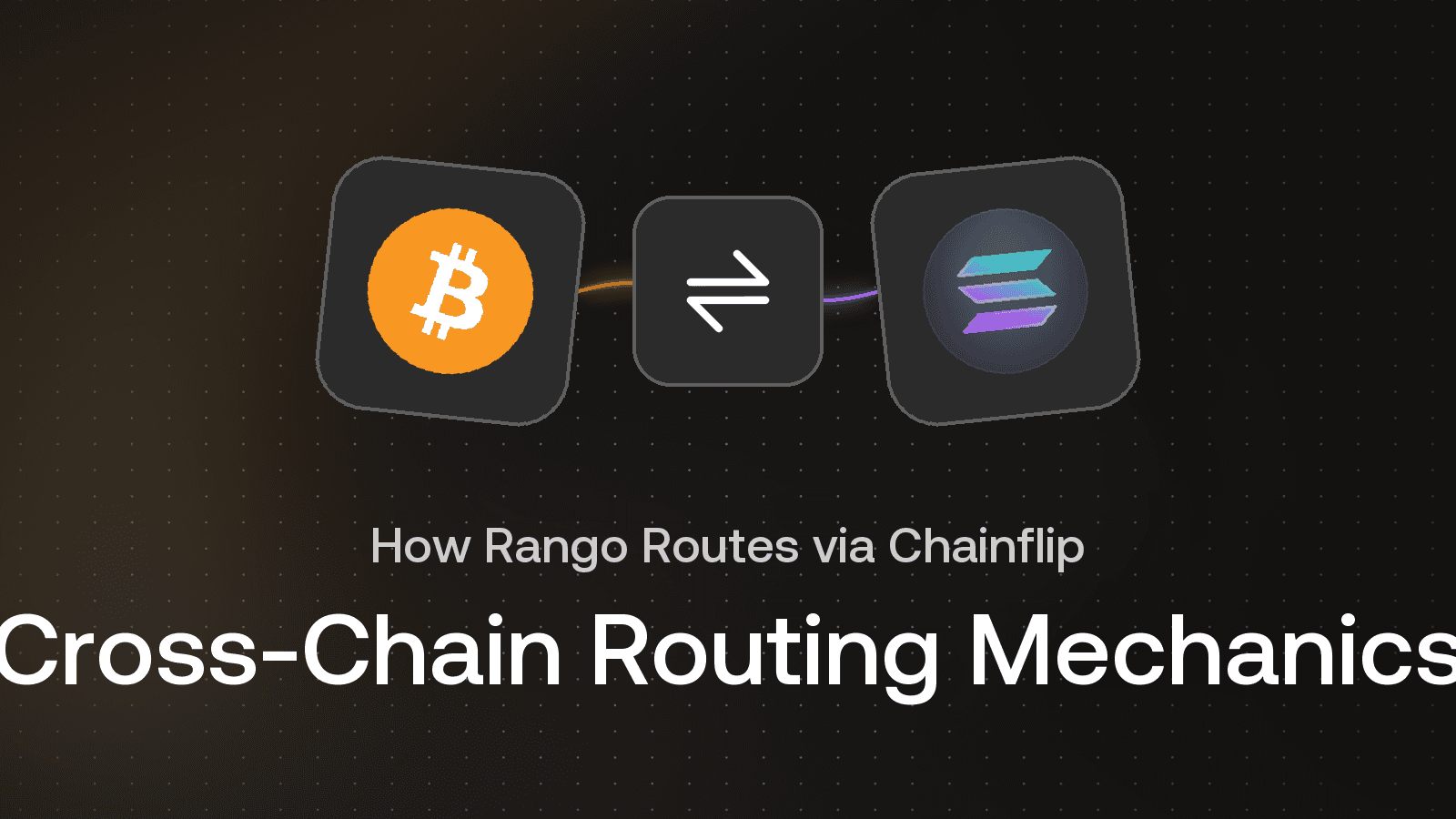
Cross-chain aggregators like Rango Exchange solve a difficult optimization problem: given thousands of possible routes across dozens of protocols, which path delivers the best outcome for a specific swap? Understanding how Rango's routing algorithm evaluates Chainflip helps you predict when you'll see it selected and why the fees work out the way they do.
How Rango's Routing Algorithm Works
Rango's pathfinding engine evaluates every integrated protocol simultaneously when you request a quote. The algorithm considers expected output amount, gas costs on source and destination chains, protocol fees, slippage estimates, and historical success rates. Chainflip enters this calculation as a direct native-to-native swap option, which changes the routing math significantly compared to bridge-based alternatives.
The algorithm assigns each potential route a composite score. For Chainflip routes, this score benefits from the absence of intermediate wrapped tokens and the protocol's JIT liquidity model, which provides tighter spreads on supported pairs. Routes through Chainflip also avoid the multi-step gas costs that bridge-based paths accumulate.
Real-World Routing Scenarios
Consider a 1 BTC to SOL swap. Rango evaluates multiple possible paths: BTC through a bridge to wrapped Bitcoin on Ethereum, then through a DEX to ETH, then bridged to Solana and swapped to SOL. Alternatively, it can route directly through Chainflip's native BTC/SOL path. The algorithm calculates total expected output after all fees.
For this swap, the bridge path might involve: 0.1% bridge fee, $15-30 in Ethereum gas, 0.3% DEX fee, another bridge fee, and Solana gas. The Chainflip path has a single protocol fee (typically 0.05-0.15% depending on pool depth) plus network fees on Bitcoin and Solana only. On a 1 BTC swap, this difference can exceed $100 in the user's favor.
A smaller swap tells a different story. For 0.01 BTC to SOL, fixed costs matter more than percentage fees. If Chainflip's minimum swap requirements aren't met or if liquidity depth creates unfavorable pricing for small amounts, Rango may route through alternative protocols.
Fee Breakdown: Chainflip Routes vs Alternatives
When Rango selects Chainflip, the fee structure typically includes: network fee on the source chain (paid by user), Chainflip protocol fee (0.05-0.15%), liquidity provider spread (variable based on JIT competition), and network fee on the destination chain (deducted from output).
Compare this to a typical bridge-based route: source chain gas, bridge protocol fee (0.05-0.3%), intermediary chain gas, DEX swap fee (0.05-0.3%), destination bridge fee, destination chain gas. The cumulative percentage and fixed costs regularly exceed Chainflip's single-hop structure.
For a concrete example: swapping 0.5 ETH to native BTC through a bridge path might cost $8-15 in total fees across steps. The same swap through Chainflip typically costs $3-6, depending on current liquidity conditions. These numbers shift based on gas prices and pool depth, which is exactly why Rango re-evaluates routes for every quote.
Supported Trading Pairs Matrix
Chainflip's current asset support determines which swaps can route through the protocol. As of the current deployment, Rango can route through Chainflip for any combination of these assets:
Bitcoin: BTC, wBTC
Ethereum: ETH, USDC, USDT, FLIP
Solana: SOL, USDC, USDT
Polkadot Assethub: DOT, USDC, USDT
Arbitrum: ETH, USDC, USDT
Any swap between these assets is eligible for Chainflip routing. Swaps involving assets outside this set (like AVAX, MATIC, or tokens on other chains) cannot route through Chainflip and will use alternative protocols in Rango's network.
When Users Should Expect Chainflip Selection
Rango favors Chainflip routes under specific conditions. Native asset swaps (not ERC-20 to ERC-20 on the same chain) where both assets are supported will almost always evaluate Chainflip. The algorithm tends to select Chainflip when swap size exceeds approximately $500, where the protocol's fee efficiency outweighs any fixed cost advantages of smaller-swap-optimized protocols.
Liquidity thresholds also influence selection. Chainflip's pools must have sufficient depth to execute the swap with acceptable slippage. For major pairs like BTC/ETH, BTC/USDC, and ETH/SOL, this threshold is rarely a concern. For smaller pairs like DOT/FLIP, larger swaps might route differently if pool depth is limited.
The algorithm also considers historical success rates. Chainflip's completion rate and average execution time factor into the composite score. Since Chainflip swaps typically complete in 5-15 minutes for Bitcoin-involved pairs (limited by Bitcoin block times) and faster for non-Bitcoin pairs, this timing is competitive with most bridge alternatives.
Understanding Route Confidence
Rango displays estimated output ranges for each route. Chainflip routes typically show tighter ranges because the JIT liquidity model provides more predictable execution. Market makers compete to fill orders at the moment of execution, which reduces the gap between quoted and actual output.
You can verify whether Chainflip was selected by checking the route details in Rango's interface before confirming. The protocol name appears in the route breakdown, along with expected fees at each step. For Chainflip routes, you'll see a single swap step rather than multiple bridge and DEX operations.
For users who want to track their Chainflip swaps independently, Chainflip Scan provides transaction-level visibility into swap execution, including actual fees paid and completion times.
Optimizing Your Rango Swaps
If you prefer Chainflip's native swap approach, structure your swaps to favor its selection. Swap between supported assets directly rather than through intermediary tokens. Consider batch timing for larger amounts rather than many small swaps. Check Rango's route preview to confirm Chainflip selection before executing.
The aggregator model means you don't need to manually select Chainflip. Rango's algorithm handles route optimization automatically. But understanding the mechanics helps you predict outcomes and verify that your swaps are routing through the infrastructure you expect.
Resources
Swap Now - Start swapping native assets
Lend BTC - Borrow against native Bitcoin
Blog - Product updates and announcements
Chainflip Scan - Track swaps and network activity
Website - Explore Chainflip
Other Chainflip Products:
Boost - Earn fees by providing single-sided liquidity with no IL risk
Stablecoin Strategies - Deposit stablecoins and earn optimized yields
Provide Liquidity - Supply assets to Chainflip's liquidity pools
Stake FLIP - Delegate FLIP and earn staking rewards
Find us:
How does Rango decide when to use Chainflip for a swap?
Rango's algorithm evaluates all available routes simultaneously, considering expected output, total fees, gas costs, and historical success rates. Chainflip is favored when both assets are natively supported, swap size exceeds roughly $500, and pool liquidity is sufficient for acceptable slippage.
What fees are involved when Rango routes through Chainflip?
Chainflip routes include source chain network fees, a protocol fee of 0.05-0.15%, a variable liquidity provider spread, and destination chain network fees. This single-hop structure typically costs less than multi-step bridge routes, which accumulate fees at each stage.
Which trading pairs can route through Chainflip on Rango?
Any combination of supported assets: BTC, wBTC, ETH, SOL, DOT, USDC, USDT, and FLIP across Bitcoin, Ethereum, Solana, Polkadot Assethub, and Arbitrum networks. Swaps involving assets outside this set use alternative protocols.
Why might Rango choose a different protocol instead of Chainflip?
For very small swaps where fixed costs dominate, assets not supported by Chainflip, or when temporary liquidity conditions make alternative routes more competitive, Rango will select different protocols to optimize user outcomes.
How can I verify my swap routed through Chainflip?
Check the route details in Rango's interface before confirming. Chainflip routes show a single swap step rather than multiple bridge operations. After execution, track the transaction on Chainflip Scan for detailed swap information.