FLIP is the native token of Chainflip, a decentralized protocol that enables cross-chain swaps between native assets like Bitcoin, Ethereum, and Solana. But FLIP does more than just exist. It secures the network, captures protocol revenue, and distributes that value back to stakers.
This guide covers everything: token utility, staking mechanics, the FLIP 2.1 buy-and-distribute model, and how swap fees flow from users to token holders.
What Does FLIP Actually Do?
FLIP serves three core functions within the Chainflip protocol.
Network security
Chainflip is secured by 150 validators (CoinGecko) who stake FLIP to participate in the network. Validators hold the private keys that control Chainflip's liquidity vaults across connected chains. The more FLIP staked, the higher the economic security backing user funds.
Revenue capture
Every swap on Chainflip generates fees. Under the current tokenomics, 0.1% of swap volume is used to buy FLIP from the market. This creates direct demand pressure tied to protocol activity.
Yield distribution
Stakers earn rewards from two sources: validator emissions and the upcoming buy-and-distribute mechanism. The combination means FLIP holders can earn yield simply by delegating their tokens to a validator.
FLIP 2.1 Tokenomics: The Buy-and-Distribute Model
In Q3 2026, Chainflip will upgrade to FLIP 2.1 tokenomics, replacing the previous burn-only model with buy-and-distribute.
How buy-and-distribute works
Currently, protocol revenue buy and burn FLIP permanently. Under FLIP 2.1, the mechanism will change. Revenue still buys FLIP from the market, but instead of burning those tokens, they get distributed to stakers as additional rewards.
The flow works like this:
Users swap assets on Chainflip
Swap fees accumulate as protocol revenue
Revenue is used to purchase FLIP on the open market
Purchased FLIP is distributed proportionally to stakers
This creates a direct link between Chainflip's trading volume and staker yield. More swaps mean more FLIP purchased, which means higher rewards for stakers.
Why the change from burning?
Burns reduce supply, which can increase token value over time. But buy-and-distribute provides immediate, tangible yield to active participants. It rewards people who are actually staking and securing the network rather than passive holders.
The model also makes staking rewards more sustainable. Instead of relying purely on inflation-based emissions, a portion of rewards comes from real protocol revenue.
The Burn History: Over 11.85 Million FLIP Removed
Before the transition to buy-and-distribute, Chainflip operated a burn mechanism for over a year. The results were significant.
As of February 2026, 7.3 million FLIP tokens had been burned. Since then, additional burns have pushed the total past 11.85 million FLIP removed from circulation permanently.
These burns came from the 0.1% swap fee that was previously directed entirely to buybacks and burns. With Chainflip processing over $8.22 billion in all-time swap volume (see Chainflip Scan for current stats), the burn mechanism had real impact on circulating supply.
The FLIP 2.1 upgrade doesn't eliminate burns entirely. A portion of revenue may still be burned depending on governance decisions. But the primary mechanism now directs purchased FLIP to stakers.
How FLIP Staking Works
There are two ways to stake FLIP and earn rewards: running a validator node yourself or delegating to an existing validator.
Validator staking
Running a validator requires technical expertise and infrastructure. Validators participate in Chainflip's threshold signature scheme, helping secure cross-chain transactions. In exchange, they earn the highest staking yields.
Validator operators can earn up to 48% APY for running their own nodes. This rate reflects the additional work and risk involved in maintaining validator infrastructure.
Delegation
Most FLIP holders delegate to existing validators rather than running their own. Delegation is simple: you choose a validator, stake your FLIP, and earn a share of their rewards minus a commission fee set by the validator.
Current delegation yields reach up to 12% as of July 14th 2026. Actual rates vary based on which validator you choose and network conditions.
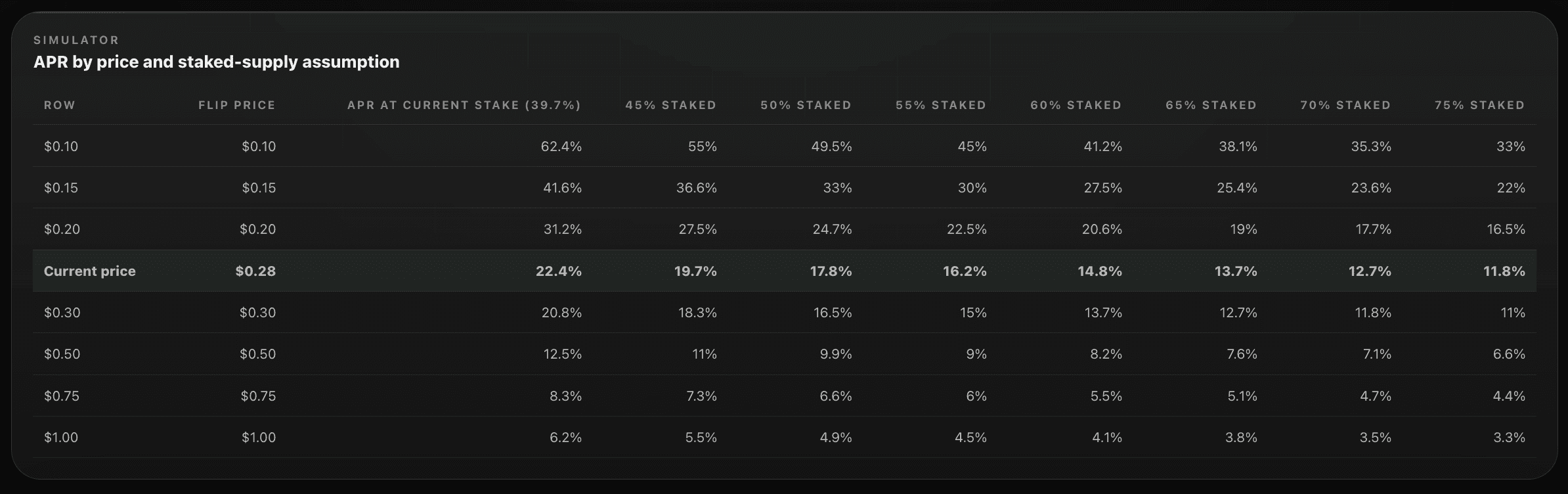
In FLIP 2.1 this APY would be 22.4%. See the 2.1 economics APR simulator:
You can start staking through the Chainflip delegation interface.
Where Staking Rewards Come From
FLIP staking rewards have two sources.
Validator emissions
The Chainflip protocol emits new FLIP tokens as rewards for validators. This emission rate has been reduced over time as the protocol matures and buy-and-distribute revenue increases.
Buy-and-distribute revenue
This is the portion of staking yield that will come directly from protocol activity. When users swap on Chainflip, fees are collected. Those fees buy FLIP. That FLIP goes to stakers.
The combination means staking rewards scale with protocol usage. If Chainflip volume grows, buy-and-distribute rewards grow proportionally.
The End-to-End Revenue Flow
To understand FLIP tokenomics completely, trace how value moves from users to stakers:
A user swaps ETH for native BTC on Chainflip
The swap incurs fees (network fees, liquidity provider spread, and protocol fee)
0.1% of swap volume goes to the protocol as revenue
Protocol revenue accumulates in a treasury contract
Periodically, the treasury uses accumulated revenue to buy FLIP on the market
Purchased FLIP is distributed to all stakers proportional to their stake
This creates a flywheel effect. More volume means more revenue. More revenue means more FLIP purchased. More purchasing creates demand pressure on the token while simultaneously rewarding active stakers.
Comparing FLIP to Other Protocol Tokens
Many DeFi protocols have native tokens, but tokenomics vary significantly.
Some tokens are purely governance-focused with no revenue capture. Others capture fees but distribute them as a different asset (like ETH or stablecoins). FLIP will use the buy-and-distribute model to keep value within the token itself.
The key difference with FLIP is the direct connection to swap volume. There's no governance vote needed to enable fee sharing. The mechanism is built into the protocol and operates automatically.
Getting Started with FLIP
If you want to participate in FLIP staking, the process is straightforward.
First, acquire FLIP tokens. You can swap for FLIP on Chainflip itself or on Ethereum DEXes since FLIP is an ERC-20 token. Find out where here.
Second, visit the staking interface and choose a validator. Look at commission rates and historical performance when selecting.
Third, delegate your FLIP. Rewards begin accruing immediately and can be claimed or compounded at any time.
For a detailed walkthrough, check the complete staking guide.
Resources
Swap - Start swapping native assets
Lending - Borrow against native Bitcoin
Blog - Product updates and announcements
Chainflip Scan - Track swaps and network activity
Website - Explore Chainflip
Earn with Chainflip:
Boost - Earn fees by providing single-sided liquidity with no IL risk
Stablecoin Strategies - Deposit stablecoins and earn optimized yields
Provide Liquidity - Supply assets to Chainflip's liquidity pools
Stake FLIP - Delegate FLIP and earn staking rewards
Find us:
What is the FLIP token used for?
FLIP secures the Chainflip network through validator staking, captures protocol revenue through the buy-and-distribute mechanism, and provides yield to stakers. It's the economic backbone of Chainflip's decentralized cross-chain swap infrastructure.
How much can I earn staking FLIP?
Delegation yields reach up to 14.39% APY, while validator operators running their own nodes can earn up to 48% APY. Actual rates depend on the validator you choose and current network conditions.
What is buy-and-distribute?
Buy-and-distribute is Chainflip's revenue-sharing mechanism. Protocol fees from swaps are used to purchase FLIP from the market, then distribute that FLIP directly to stakers as additional rewards. It connects swap volume to staking yield.
How many FLIP tokens have been burned?
Over 7.9 million FLIP tokens have been burned since the protocol launched. Burns came from the previous tokenomics model where 0.1% of swap volume was used to buy and permanently remove FLIP from circulation.
How do I start staking FLIP?
Visit the Chainflip staking interface at auctions.chainflip.io/delegate, select a validator based on their commission rate and performance, and delegate your FLIP tokens. Rewards begin accruing immediately.