DCA into Bitcoin means buying a fixed dollar amount at regular intervals regardless of price. It sounds simple because it is. The power lies in the consistency.
Why Bitcoin's Volatility Makes DCA Essential
Bitcoin has been three to nearly four times as volatile as various equity indices from 2020 to 2024 (Fidelity Digital Assets). That level of price movement makes timing the market nearly impossible for most investors.
When you try to time entries, you're betting you can consistently predict short-term price movements. The data suggests even professionals fail at this regularly. DCA sidesteps the problem entirely by spreading purchases across time.
Your average cost per Bitcoin ends up somewhere between the highs and lows of your accumulation period. You'll never catch the absolute bottom, but you'll never catch the absolute top either.
The Math Behind Bitcoin DCA Returns
Historical data makes a compelling case for this approach. A $10 weekly Bitcoin DCA from 2019 to 2024 returned 202% on a total investment of $2,610 (SpotedCrypto). That's a modest commitment yielding substantial results over five years.
Extend the timeframe and the numbers become more dramatic. A $100 monthly DCA from January 2014 to early 2026 turned $14,600 into $994,950, a 6,712% return (SpotedCrypto).
The magic happens because you accumulate more BTC when prices dip and less when they spike. Over time, this mechanical approach outperforms most discretionary buying strategies.
The Psychology That Makes DCA Work
Numbers aside, DCA solves a human problem: we're terrible at managing emotions around money. When Bitcoin drops 30%, the logical move is to buy more. The emotional response is to sell or freeze.
DCA removes the decision from the moment. Your $100 goes in this week whether Bitcoin is at $40,000 or $60,000. There's no agonizing over whether now is the right time.
This consistency builds positions that emotional traders never accumulate. They're always waiting for a better entry that may never come, or selling during dips they should have bought.
Practical DCA Schedules for Bitcoin Accumulation
Your ideal DCA frequency depends on your income timing and commitment level. Weekly purchases create smoother cost averaging since you catch more price variation. Monthly purchases are simpler to manage and still effective over longer timeframes.
Consider these common approaches:
Weekly: Best for maximizing smoothing effect. Works well for those with steady cash flow.
Bi-weekly: Aligns with typical pay schedules. Good balance of simplicity and averaging.
Monthly: Minimum viable frequency. Still captures significant price variation over years.
The specific amount matters less than consistency. Start with what you can commit to for 2-3 years minimum without touching.
DCA Without Centralized Exchange Risk
Most people execute DCA through centralized exchanges. This creates custody risk that contradicts Bitcoin's core value proposition. Your accumulated BTC sits on someone else's servers, vulnerable to exchange failures, hacks, or freezes.
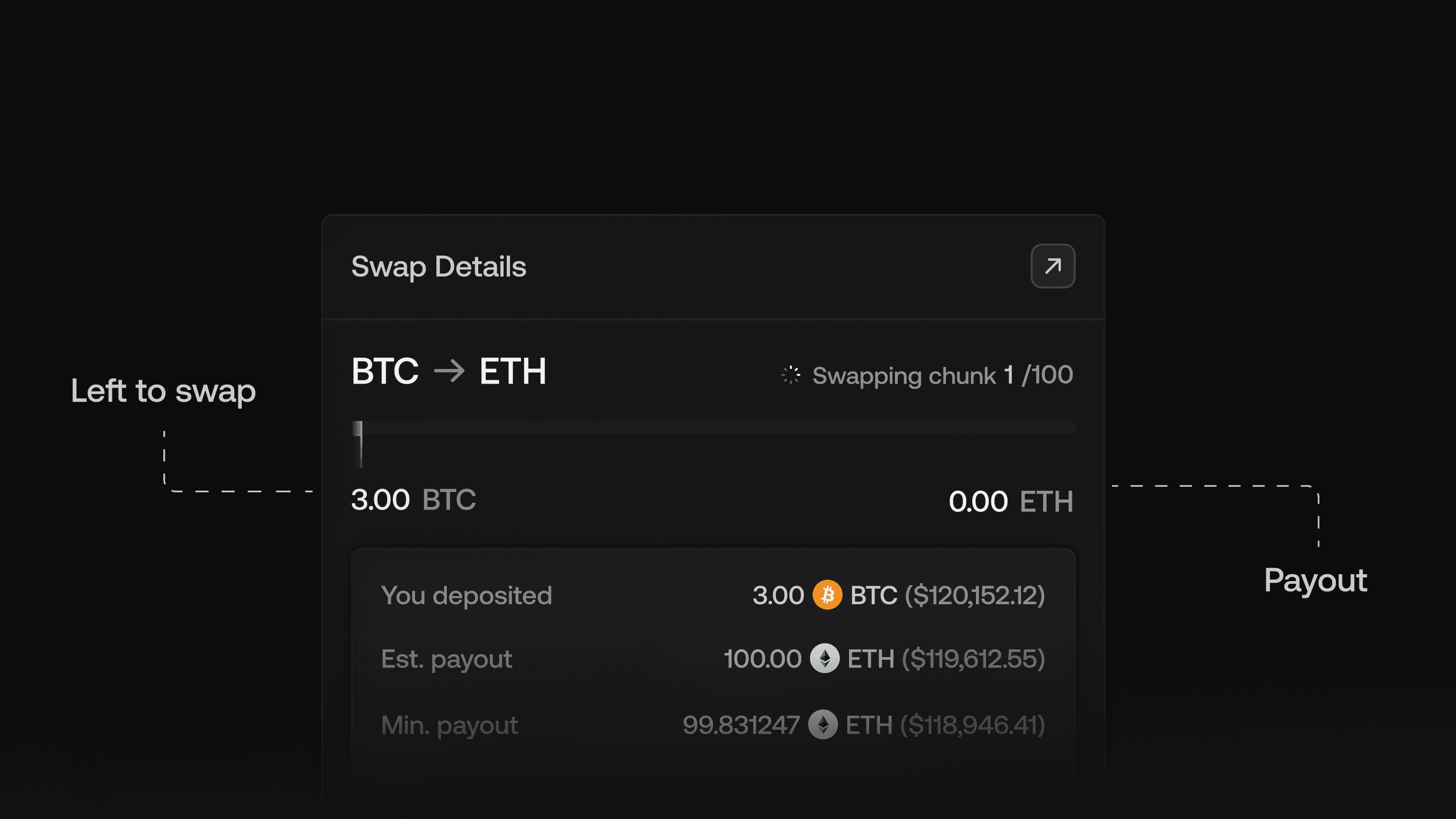
Chainflip's DCA feature offers a different approach. The protocol splits swaps into chunks with configurable intervals to maximize payout and optimize pricing (Chainflip Documentation). You can convert ETH, SOL, or other assets into native Bitcoin on a schedule, with funds going directly to your own wallet.
This matters because Chainflip's security architecture uses a decentralized custody model secured by validators. There's no centralized custodian holding your assets between swaps.
How Chainflip DCA Works for Bitcoin Accumulation
Say you hold ETH but want to gradually rotate into Bitcoin. Rather than making one large swap and eating potential slippage, you can set up recurring smaller swaps.
Chainflip charges a flat 0.10% protocol fee on all swaps (Chainflip Blog). For DCA purposes, this predictable cost structure lets you calculate your true accumulation rate upfront. If you're swapping from ETH to BTC or even SOL to BTC, the process works the same.
The Bitcoin arrives in your wallet as native BTC. Not wrapped tokens, not IOUs, actual Bitcoin you control with your own keys.
When DCA Might Not Be Optimal
DCA isn't universally superior. If you have a lump sum and Bitcoin subsequently rises continuously, deploying everything immediately would outperform. But you only know this in hindsight.
The strategy also assumes a long-term bullish thesis on Bitcoin. If you believe BTC will trend toward zero, averaging into it makes no sense. DCA is for accumulating an asset you expect to appreciate over years.
Short timeframes also reduce DCA's effectiveness. Over three months, you might not catch enough price variation to meaningfully smooth your entry. This is a multi-year strategy.
Building a Bitcoin Position That Lasts
The best DCA strategy is one you'll actually follow. Set an amount that won't strain your finances during tough months. Choose a frequency that matches your income. Then automate as much as possible to remove friction.
With Chainflip, you can execute this strategy while maintaining custody of your Bitcoin throughout. No exchange accounts to fund, no withdrawal delays, no custody risk between purchases.
Dollar-cost averaging won't make you rich overnight. It's designed to build wealth steadily while protecting you from the emotional mistakes that derail most investors.
Resources
Swap Now - Start swapping native assets
Lend BTC - Borrow against native Bitcoin
Blog - Product updates and announcements
Chainflip Scan - Track swaps and network activity
Website - Explore Chainflip
Other Chainflip Products:
Boost - Earn fees by providing single-sided liquidity with no IL risk
Stablecoin Strategies - Deposit stablecoins and earn optimized yields
Provide Liquidity - Supply assets to Chainflip's liquidity pools
Stake FLIP - Delegate FLIP and earn staking rewards
Find us:
Frequently Asked Questions
What is the best frequency for Bitcoin DCA?
Weekly DCA provides the smoothest cost averaging because it captures more price variation. However, monthly purchases still work effectively over multi-year timeframes and are easier to manage for most people.
Does DCA guarantee profits on Bitcoin?
No strategy guarantees profits. DCA assumes Bitcoin will appreciate over the long term. It reduces the risk of poor timing but doesn't eliminate the risk of Bitcoin declining in value.
How is DCA through Chainflip different from using a CEX?
Chainflip swaps send native Bitcoin directly to your wallet. Centralized exchanges hold custody of your BTC until you withdraw, creating counterparty risk from potential hacks, insolvency, or account freezes.
What's the minimum amount needed to start Bitcoin DCA?
There's no strict minimum. The key is consistency over time. Even small weekly amounts compound significantly over years, as shown by the 202% return on $10 weekly purchases from 2019 to 2024.
Can I DCA from stablecoins into Bitcoin on Chainflip?
Yes. Chainflip supports USDC and USDT on multiple chains including Ethereum, Solana, Arbitrum, and Polkadot Assethub. You can set up recurring swaps from stablecoins to native BTC.

